Definition: what is a customer wallet?
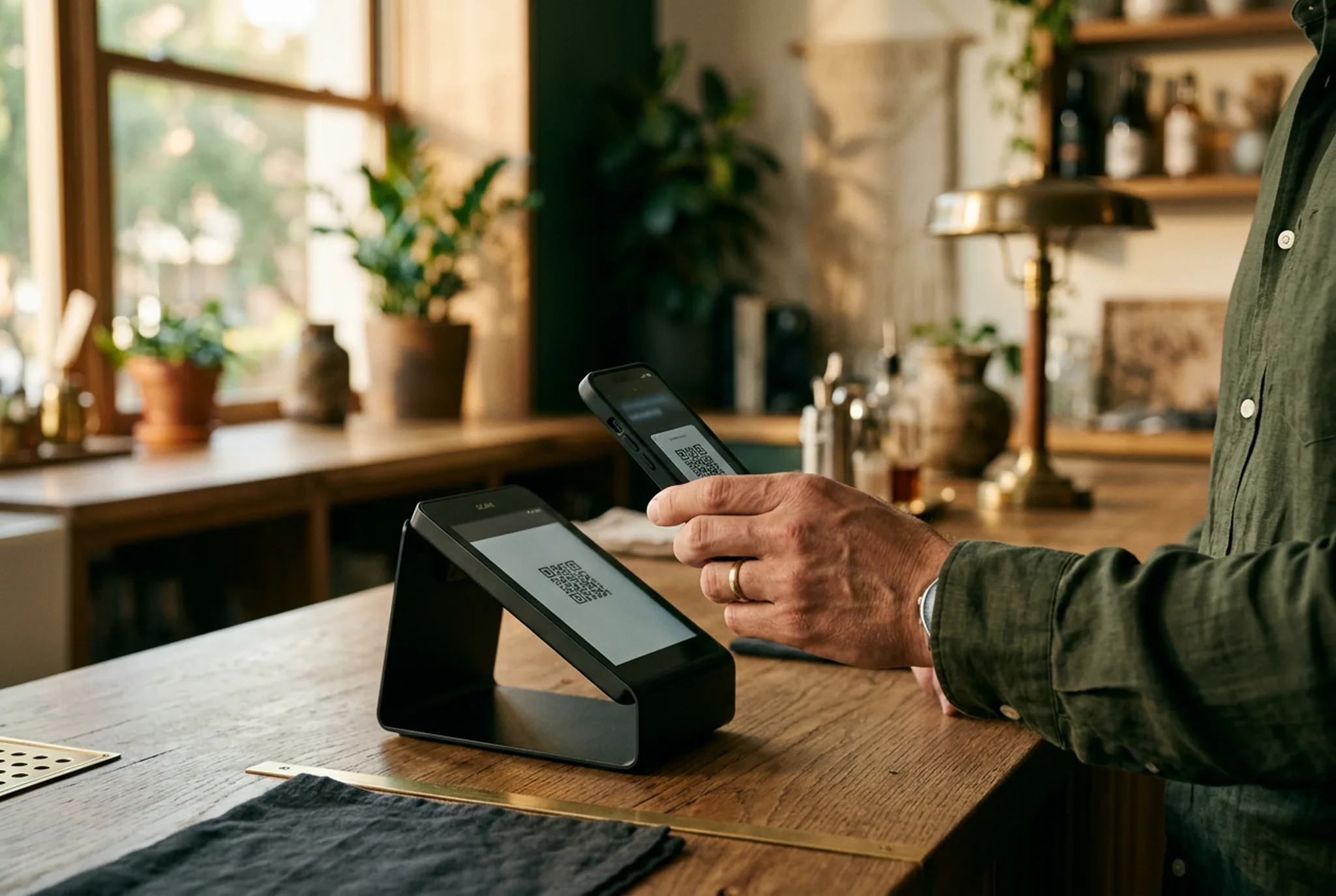
A customer wallet is a prepaid store of value attached to a customer's account, which they top up in advance and then spend on their purchases. In concrete terms, the customer loads an amount onto their wallet — in store or online — then pays for their next orders straight from that balance, usually by scanning a QR code.
It's different from a classic points program: the wallet is real money deposited in advance, whereas points are a reward unit earned with each purchase. The two can coexist in a single tool, but they follow distinct logics — one funds, the other rewards.
Before the wallet: the physical prepaid card
Prepaid cards have existed in hospitality for decades, in very simple forms: a cardboard card punched at each purchase, or a magnetic card reloaded at a venue's front desk. The principle always stayed the same — the customer puts money forward, and the restaurateur draws it down at each visit.
This system had a real merit: it built loyalty without technical complexity. But it also carried structural limits. The card could be lost, forgotten or simply damaged. The restaurateur had no visibility into how the program was actually used — how many cards were active, what balance was in circulation, how often customers reloaded. The card lived in a cash drawer, disconnected from any usable data.
The transition: gift cards and points systems
As commerce gradually went digital, electronic gift cards started to replace paper versions. They brought real progress — traceability, email delivery, partial integration with POS software. But they were often still designed as a one-off gesture (give, receive) rather than a recurring loyalty tool.
In parallel, points programs became widespread — collect points with each purchase, redeem them for a reward. This system has its uses, but it answers a different logic from the wallet: it rewards frequency without necessarily building a store of value the customer can spend directly.
The two logics — prepaid card and points system — long coexisted without truly coming together in a single coherent tool.
Today: the integrated digital wallet
What defines the modern customer wallet is integration. The wallet is no longer a separate tool — it lives directly inside the restaurant's POS software and in the customer's phone.
In practice, the customer tops up their balance once, then pays with a single QR scan at every visit. The balance, the history and the loyalty points are visible in real time, with no physical card to hunt for. For the restaurateur, every transaction is tracked, every top-up is usable data, and the whole program is managed from a single dashboard.
This integration changes the very nature of the wallet: it becomes a permanent point of contact between the customer and the venue, not just an occasional means of payment.
What the wallet delivers in practice
For the customer
A simpler checkout, with no hunting for change or a card. A clear view of their balance and benefits, available anytime from their phone.
For the restaurateur
A pre-top-up that engages the customer even before their next visit. Precise data on program activity — number of active accounts, top-up frequency, average amount — usable to fine-tune rewards.
For the customer relationship
The wallet creates a habit. A customer who has already topped up their balance has a concrete reason to come back, without any promotion needed to nudge them.
Where the customer wallet is heading
The wallet is becoming the central point of a broader experience, beyond simple payment. Three trends are emerging.
Convergence with loyalty
Wallet and loyalty points are gradually merging into a single interface — one transaction credits both the spent balance and the points earned, with no double entry or separate tool.
Simplified identification
The personal QR code, already used for payment, also becomes the way to identify the customer instantly at the counter — speeding up service while personalising the welcome.
Data as a decision lever
Restaurateurs increasingly get a clear view of their loyalty program's activity, letting them adjust rewards, point ratios or offers based on real data rather than gut feeling.
The customer wallet at SUPERKAWA OS
SUPERKAWA OS builds the customer wallet natively into its POS software — no separate module, no third-party app to connect. The customer tops up their balance, is identified at checkout by QR code, and automatically collects loyalty points in the same interface.
Read next
Take action
Try SUPERKAWA OS free for 14 days
Customer wallet and loyalty included from the very first plan.
Get started for free See pricingSuperkawa®
POS software, loyalty and customer wallet for independent restaurants.